Island Park is the snowmobile capital of the Lower 48, with over 400 miles of groomed trails connecting to the Continental Divide Snowmobile Trail (CDST), Two Top, Mesa Falls, and West Yellowstone. Trail season typically runs mid-December through mid-March, depending on snow. Idaho requires a snowmobile registration sticker; full-day rentals run $250–$400 per machine.
Why Island Park is the place
Island Park sits between the Centennial Mountains and the Yellowstone Plateau, in a high-elevation valley that catches reliable lake-effect-style snow from late November through March. The Idaho Department of Parks and Recreation lists Island Park among the state’s premier snowmobile destinations. Visit Idaho calls it “Idaho’s crown jewel of snowmobiling.” The numbers behind that claim: more than 500 miles of groomed trails, connecting to 800+ additional miles in West Yellowstone and northwest Wyoming (IDPR).
What that means in practice: from a cabin in Island Park, you can ride for a week without crossing the same trail twice. The Continental Divide Snowmobile Trail (CDST) crosses through here and connects to the Two Top trail system in Montana, the West Yellowstone groomed network, and the Yellowstone non-commercial guided access program. A single morning’s ride can take you through three states.
The trails that matter
Two Top Trail (30-mile loop)
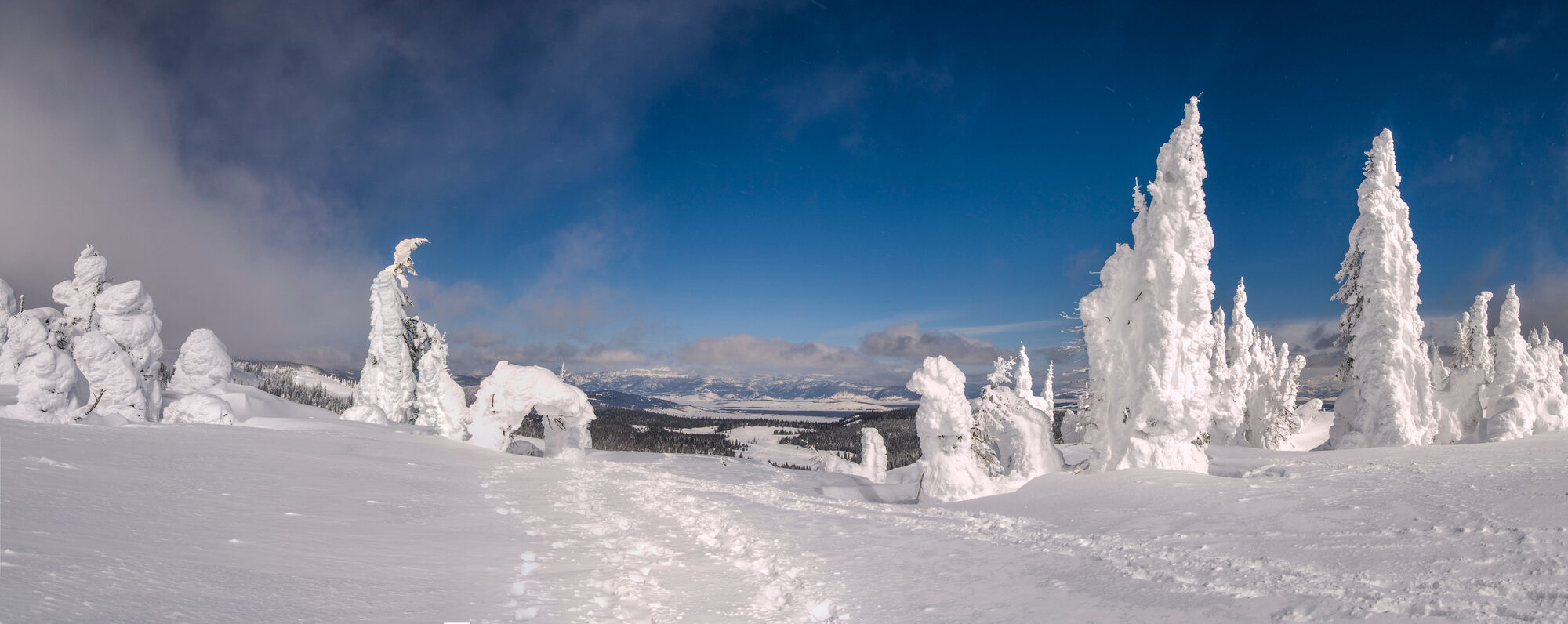
The single most famous snowmobile trail in this region, and arguably in North America. Two Top is a 30-mile loop starting in West Yellowstone, with a 2,000-foot elevation gain to the ridge of the Centennial Mountains. At the summit, constant wind transforms trees into “snow ghosts” — pillars of compressed ice and rime that turn the upper ridge into something between sculpture garden and lunar landscape.
From the top, you can see Wyoming’s Tetons, Idaho’s Centennial Mountains, Lionhead in Montana, and the Yellowstone Plateau in a single 360-degree turn (Visit Montana).
This is the canonical first-day ride. Plan three to four hours round-trip from West Yellowstone, longer if you stop for photos. From Island Park, ride or trailer north to West Yellowstone (about 30 minutes by truck), then begin from there.
Continental Divide Snowmobile Trail (CDST)
The CDST is the long-distance backbone of the regional system. It traces roughly the Continental Divide between Yellowstone and the Centennials, crossing through Island Park, West Yellowstone, and into the southwestern Montana / northwestern Wyoming high country. Sections are groomed by both Fremont County (Idaho side) and the Custer Gallatin National Forest (Montana side).
From Island Park, the CDST is accessible at multiple trailheads. The Big Springs trailhead has a Forest Service warming hut capable of holding 200 people, with a wood-burning stove and pit toilets — a useful warm-up stop on long rides.
Sawtelle Mountain area
Sawtelle Peak (9,866 ft) anchors the western edge of the system. Sawtelle’s lower slopes have groomed trails for moderate riders; the upper bowls and ridges offer powder skiing for advanced sled drivers with backcountry skills and avalanche awareness. The Centennial Range has been the location of multiple snowmobile fatalities in recent winters. Backcountry riding above the groomed trails requires avalanche education, beacon/probe/shovel, and ideally a guide. Current conditions: Centennial Range avalanche forecast.
Yellowstone National Park (non-commercial guided access)
The NPS permits limited non-commercial snowmobile access into Yellowstone through the Non-commercially Guided Snowmobile Access Program (NCGSAP). You must either join a commercial guided tour, or hold a current NCGSAP permit and travel in a permitted party. Independent snowmobile travel into the park is not allowed. Application details and current rules: nps.gov/yell/planyourvisit/ncgsap.htm.
Big Springs & Mack’s Inn loops
For mellower rides, the Big Springs and Mack’s Inn area at the north end of Island Park has well-groomed beginner-to-intermediate trails through forested valley. Family groups and first-time riders often start here.
When to ride
Season window
The Island Park snowmobile season generally runs mid-December through mid-March. Early-season snow is variable; late-March riding is good in big snow years but becomes patchy in low ones. The reliable core is mid-January through early March.
Daily conditions
Fremont County maintains a real-time trail report and conditions blog. Three things to check before heading out:
- Fremont County Snowmobile Trail Report — grooming status, recent reports.
- Idaho Trail Mapping (idaho.evtrails.com) — interactive map of groomed trails statewide.
- Centennial Range avalanche forecast — required reading before going off the groomed system.
Cell coverage warning
Cell coverage in the snowmobile country is poor to nonexistent. Carry a paper map or downloaded offline map. The Forest Service publishes a free interactive Visitor Map for the Caribou-Targhee National Forest available as a web app or mobile app (fs.usda.gov/ivm).
Where to rent
Three established Island Park-area rental operators. Reservations matter — January and February book up by Thanksgiving most years.
Polaris Adventures / Island Park
Polaris's factory rental program with multiple Island Park area outlets. New machines, full insurance options, hourly through full-day rentals. Reservations recommended in peak season (January and February).
Island Park Backcountry Rentals
Local outfitter with sleds from all three major manufacturers (Polaris, Ski-Doo, Arctic Cat). Multi-day rentals, guided options, and gear (helmets, bibs, boots) available.
High Mountain Adventures
Rentals plus guided tours on the Centennial Range and through the Yellowstone non-commercial guided access program. The guided option is the safer call for first-time visitors to the area.
Rules, licenses, and safety
Idaho snowmobile registration
Every snowmobile operated in Idaho must be registered. The Idaho Snowmobile Sticker is purchased annually and funds grooming on state trails. Non-Idaho-registered sleds must purchase a non-resident sticker — purchasable at most local outfitters and at parksandrecreation.idaho.gov/activities/snowmobiling/.
Riding rules
- Stay on designated trails and groomed routes through neighborhoods.
- Slow speed (under 15 mph typically) through residential subdivisions.
- Do not ride on private property without permission.
- Yield to grooming equipment and uphill traffic.
- Helmets are not legally required in Idaho but are universally recommended.
Avalanche awareness
The Centennial Mountains have produced multiple fatal slides in recent winters. Any riding above the groomed trail system in the Sawtelle, Lionhead, or Two Top high country requires avalanche education, an avalanche transceiver, a probe, a shovel, and ideally a guide. The Centennial Range avalanche awareness page publishes current conditions and incident history.
Yellowstone-specific rules
To ride a snowmobile inside Yellowstone, you must either: (1) be part of a commercially guided tour, or (2) hold a current Non-commercially Guided Snowmobile Access Program (NCGSAP) permit. Permits are limited and assigned by lottery. Application opens in late summer for the following winter. Details: nps.gov/yell/planyourvisit/ncgsap.htm.
What to bring
Clothing
Layers matter more than thickness. Base layer (merino wool or synthetic), mid layer (fleece or light puffy), outer shell (bib snowpants + insulated snowmobile jacket — most rental outfits include these). Wool socks. Glove liners under insulated gloves. Balaclava for face protection.
Riding at 30 mph in 5°F creates a wind chill below -20°F. Anything cotton becomes a problem fast. The rule from experienced riders: if you can’t feel your fingers, stop and warm them.
On-trail kit
- Helmet (most rental outfits provide; you can also bring your own)
- Goggles plus a spare pair (they fog and ice up routinely)
- Hand warmers
- Water (carried inside a layer so it doesn’t freeze)
- High-calorie snacks
- Compact emergency kit: matches, fire starter, knife, small first aid
- Avalanche kit if going off-trail: beacon, probe, shovel
For the truck
Extra blankets and water in your vehicle parked at the trailhead. Block heater plugged in if temperatures drop below -10°F.
Where to stay
Most Grandview cabins are set up specifically for snowmobile trips: trailer-friendly parking, ground-floor mudrooms for wet gear, easy trail access from the property. Two recommended for snowmobile-first trips:
- Teton View Retreat — Both Domes — 68 sleepers, the right call for large snowmobile groups. Plenty of trailer parking.
- Trails End Lodge — the name is literal. Direct trail access. Sized for mid-size groups.
Browse all seven cabins for capacity and location.
Questions, answered
Do I need a guide?
For first-time visitors who plan to ride only the groomed trails, no — the trail network is well-marked and well-trafficked. For anyone planning to ride off the groomed system, yes, hire a guide or take an avalanche course first.
Can I ride into Yellowstone on my own?
No. Independent snowmobile access into Yellowstone is not permitted. You need either a commercial guided tour or an NCGSAP permit (lottery, limited).
When does Island Park have the best snow?
Mid-January through early March. Early December and late March can be hit-or-miss depending on the year.
How much do rentals cost?
Roughly $250–$400 per sled per day in 2026, depending on model and operator. Multi-day rates and guided packages run higher. Verify current pricing directly with the operator.
Can kids ride?
Idaho allows children to operate snowmobiles, but most rental operators require operators to be 18+ (passengers younger). Two-up sleds with a parent driving are the typical family setup.
Is Yellowstone’s west entrance open in winter for snowmobiles?
Yes, for permitted users only, approximately December 15 through March 15 (NPS). Wheeled-vehicle access is closed during this window.
Sources & further reading
- Idaho Department of Parks & Recreation — Snowmobiling
- Idaho Trail Mapping (groomed trails)
- Fremont County Snowmobile Trail Report
- Centennial Range avalanche forecast
- NPS — Non-commercially Guided Snowmobile Access Program
- NPS — Operating Dates
- Visit Montana — Two Top Loop
- Visit Idaho — Top Snowmobiling Destinations
- Polaris Adventures — Island Park
- Island Park Backcountry Rentals
- USFS Caribou-Targhee — Visitor Map